How AI Tools Will Shape Digital Marketing Strategies in 2026
Artificial intelligence is no longer just a futuristic technology discussed by tech companies. It has become a practical part of modern marketing, helping businesses understand customers, create content, automate repetitive tasks, analyze data, and improve campaign performance.
In 2026, AI in digital marketing is moving beyond simple content-generation tools. Businesses are increasingly using AI to make faster decisions, personalize customer experiences, identify opportunities, optimize advertising campaigns, and build more efficient marketing strategies.
For startups, small businesses, and established brands, the real question is no longer whether AI should be used in marketing. The question is how AI tools can be integrated into a digital marketing strategy without losing creativity, authenticity, and the human connection.
In this guide, we explore how AI tools are shaping digital marketing strategies in 2026, the major applications of AI, its benefits and limitations, and how businesses can prepare for the next stage of digital marketing
What Is AI in Digital Marketing?
AI in digital marketing refers to the use of artificial intelligence technologies to analyze information, automate marketing activities, predict customer behavior, personalize communication, and support decision-making.
AI-powered marketing tools can process large amounts of data much faster than humans. They can identify patterns, generate ideas, automate workflows, and provide recommendations that help marketers improve their campaigns.
However, AI is not replacing the entire marketing process. Instead, it is becoming a powerful assistant that helps marketers spend more time on strategy, creativity, and customer relationships.
Why AI Is Becoming Important in Digital Marketing in 2026
Digital marketing has become increasingly competitive. Customers interact with businesses across search engines, websites, social media platforms, email, videos, and online advertisements.
Managing all these channels manually can take significant time and resources.
This is where AI marketing tools can make a difference.
AI can help businesses:
- Analyze customer and campaign data
- Identify audience interests and behavior
- Generate content ideas
- Personalize customer experiences
- Automate repetitive marketing tasks
- Optimize advertising campaigns
- Support SEO research
- Predict potential customer actions
- Improve marketing productivity
- Monitor campaign performance
The biggest change in 2026 is that AI is becoming part of the overall marketing strategy, rather than being used only for individual tasks.
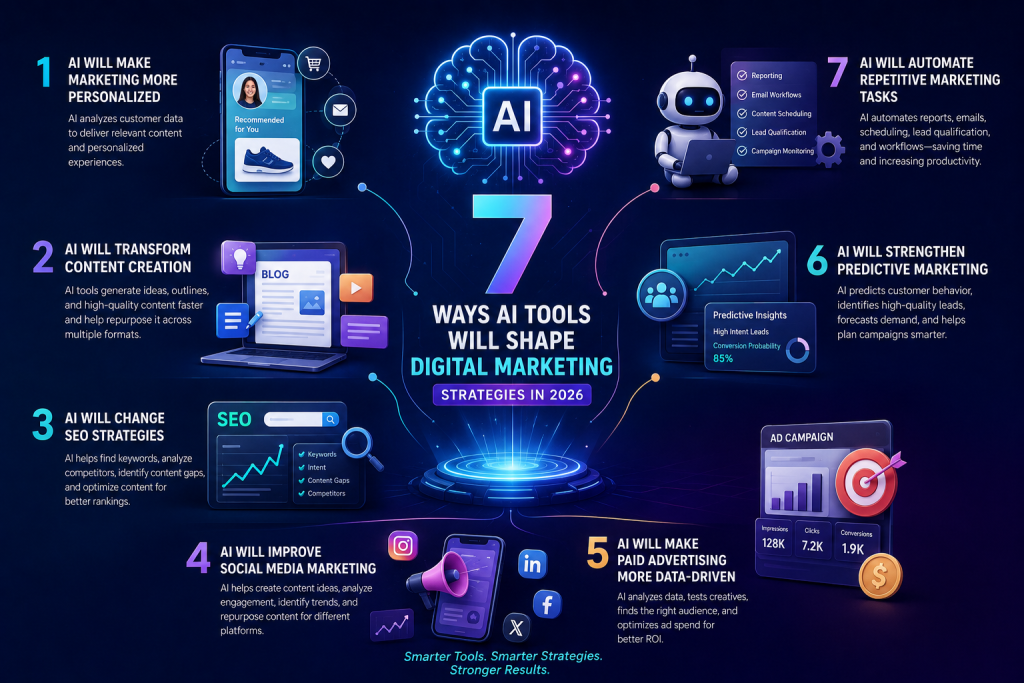
7 Ways AI Tools Will Shape Digital Marketing Strategies in 2026
1. AI Will Make Marketing More Personalized
Customers increasingly expect brands to provide relevant experiences rather than generic messages.
AI can analyze customer behavior, browsing activity, purchase history, engagement patterns, and preferences to help marketers deliver more relevant content.
For example, an e-commerce business can use AI to recommend products based on a customer’s previous interactions.
Similarly, an email campaign can use AI to determine which content or offer may be more relevant to different audience segments.
This makes personalized marketing with AI an important strategy for businesses in 2026.
Instead of creating one message for everyone, brands can create more targeted experiences for different customer groups.
2. AI Will Transform Content Creation
Content remains one of the most important parts of digital marketing.
From blog articles and social media posts to video concepts, email campaigns, and advertising copy, marketers need to produce content consistently.
AI-powered content creation tools can help with:
- Topic research
- Content ideas
- Headlines
- Blog outlines
- Social media captions
- Video concepts
- Ad copy variations
- Email drafts
- Content repurposing
But businesses should not depend entirely on AI-generated content.
Successful AI content creation will combine artificial intelligence with human expertise.
AI can help produce ideas and accelerate production, while human marketers should provide experience, originality, brand personality, fact-checking, and strategic direction.
The goal is not to publish more content simply because AI makes it easier. The goal is to publish better content that genuinely helps the audience.
3. AI Will Change SEO Strategies
Search engine optimization is also evolving.
AI is influencing how marketers conduct keyword research, analyze competitors, identify content opportunities, understand search intent, and optimize existing content.
AI for SEO can help marketers discover:
- Relevant keyword opportunities
- Related search terms
- Search intent
- Content gaps
- Topic clusters
- On-page optimization opportunities
- Competitor content patterns
However, SEO in 2026 is not simply about adding keywords to an article.
Search engines increasingly reward useful, relevant, trustworthy, and people-first content.
Therefore, businesses should use AI as an SEO assistant rather than a shortcut.
A strong strategy combines AI-powered research with original insights, expert knowledge, useful information, clear structure, and a good user experience.
4. AI Will Improve Social Media Marketing
Social media marketers have to manage multiple platforms, formats, audiences, and posting schedules.
AI can simplify many of these tasks.
AI in social media marketing can help businesses generate content ideas, analyze engagement, identify trends, assist with captions, organize content calendars, and understand which types of content perform better.
For example, a business could analyze its previous social media performance and identify that educational videos generate more engagement than promotional posts.
The marketer can then adjust the content strategy accordingly.
AI can also help transform one piece of content into multiple formats.
A long-form blog could become:
- A LinkedIn post
- An Instagram carousel
- A short video concept
- A social media caption
- An email newsletter
This makes content repurposing faster and more efficient.
5. AI Will Make Paid Advertising More Data-Driven
Paid advertising is another area where AI is having a major impact.
Platforms such as Google and Meta already use machine learning to optimize advertising delivery, audiences, bidding, and campaign performance.
In 2026, marketers will increasingly use AI advertising capabilities to test different creative variations, identify high-performing audiences, analyze campaign data, and optimize budgets.
AI can help answer questions such as:
- Which audience is responding best?
- Which creative generates stronger engagement?
- Which campaign produces better results?
- Where should the advertising budget be adjusted?
- Which messaging is generating conversions?
However, marketers still need to define the campaign objective, audience, offer, brand message, and business goals.
AI can optimize the campaign, but it cannot replace a clear marketing strategy.
6. AI Will Strengthen Predictive Marketing
One of the most valuable applications of artificial intelligence is its ability to analyze historical data and identify patterns.
This supports predictive analytics in marketing.
Businesses can use predictive insights to understand potential customer behavior, identify promising leads, estimate demand, and improve campaign planning.
For example, a company may analyze previous customer behavior to identify which leads are more likely to convert.
This can help sales and marketing teams prioritize their efforts.
Predictive marketing can therefore move businesses from simply reacting to customer behavior toward making more informed decisions about what may happen next.
7. AI Will Automate Repetitive Marketing Tasks
Marketing involves many repetitive activities.
Reporting, data organization, basic customer responses, content scheduling, email workflows, lead qualification, and campaign monitoring can consume valuable time.
AI marketing automation can reduce the amount of manual work involved in these processes.
For example, a business could create automated workflows where a new lead receives relevant information, is categorized based on behavior, and is passed to a sales team when specific conditions are met.
This allows marketers to spend less time on repetitive tasks and more time on strategy and creativity.
Benefits of AI-Powered Marketing in 2026
When implemented correctly, AI can provide several advantages.
Faster Marketing Execution
AI tools can reduce the time required for research, content development, analysis, and reporting.
Better Decision-Making
AI can analyze large amounts of information and identify patterns that may be difficult to recognize manually.
Improved Personalization
Businesses can create more relevant experiences based on customer behavior and preferences.
Increased Productivity
Automation allows marketing teams to focus on higher-value strategic activities.
Better Campaign Optimization
AI can help marketers identify performance patterns and optimize campaigns based on data.
Scalable Marketing
Small teams can use AI tools to support activities that previously required larger teams and more resources.
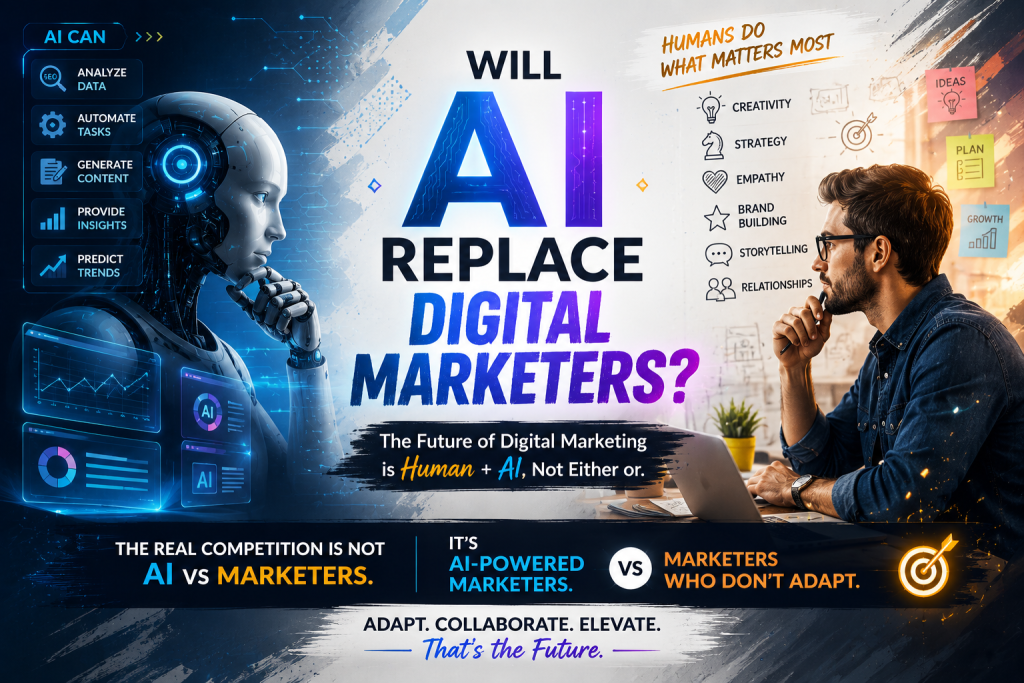
Will AI Replace Digital Marketers?
This is one of the biggest questions surrounding the future of digital marketing.
The short answer is: AI is more likely to change the role of marketers than completely replace them.
AI can generate content, analyze data, automate tasks, and provide recommendations. But effective marketing also requires creativity, emotional understanding, strategic thinking, communication, brand positioning, and knowledge of the business.
A marketer who knows how to use AI effectively may have an advantage over someone who refuses to adapt.
The future will not necessarily be AI versus marketers.
It will be marketers using AI versus marketers who do not.
Challenges of Using AI in Digital Marketing
Despite its benefits, AI also comes with challenges.
Accuracy and Fact-Checking
AI-generated information can sometimes be incorrect or outdated. Human review remains important.
Lack of Brand Personality
AI-generated content can sound generic if it is not guided by a clear brand voice.
Data Privacy
Businesses must handle customer information responsibly and follow applicable privacy requirements.
Over-Automation
Automating every customer interaction can make a brand feel impersonal.
Content Quality
Producing a large amount of AI-generated content does not automatically create better marketing results.
The solution is to use AI strategically, with appropriate human oversight.
How Businesses Can Prepare for AI-Driven Digital Marketing
Businesses don’t need to adopt every new AI tool available.
Instead, start with the problems that consume the most time or create the biggest marketing challenges.
A practical approach is:
1. Identify repetitive tasks
Find activities that can be automated without negatively affecting quality.
2. Choose the right AI tools
Select tools based on business objectives rather than popularity.
3. Build a clear content strategy
AI should support your strategy, not become your strategy.
4. Keep humans involved
Review important content, customer communication, and strategic decisions.
5. Measure results
Track metrics such as traffic, engagement, leads, conversions, and return on investment.
6. Continuously adapt
AI technology is evolving quickly, so marketing teams should regularly review their processes and tools.
The Future of Digital Marketing Is Human + AI
The biggest opportunity in 2026 is not simply using more AI.
It is using AI more intelligently.
Businesses that combine artificial intelligence with human creativity, expertise, empathy, and strategic thinking can create stronger marketing experiences.
AI can help marketers understand data.
Humans can understand context.
AI can generate ideas.
Humans can add originality.
AI can automate processes.
Humans can build relationships.
That combination will define the next generation of digital marketing.
Frequently Asked Questions
How is AI changing digital marketing in 2026?
AI is changing digital marketing by improving personalization, content creation, SEO research, social media management, advertising optimization, predictive analytics, and marketing automation.
What are the best AI tools for digital marketing?
The right tools depend on your goals. Different AI tools can support content creation, SEO, analytics, social media, advertising, customer service, and automation. Businesses should select tools based on their specific marketing requirements.
Can AI replace digital marketers?
AI can automate many marketing tasks, but it cannot completely replace strategic thinking, creativity, brand understanding, emotional intelligence, and human relationships. AI is best used as a tool that enhances marketers’ capabilities.
How can small businesses use AI for marketing?
Small businesses can use AI for content ideas, social media planning, SEO research, email marketing, customer communication, data analysis, and repetitive workflow automation.
What is the future of AI in digital marketing?
The future will focus on greater personalization, automation, predictive analytics, AI-assisted content creation, smarter advertising, and deeper integration between AI systems and marketing platforms.