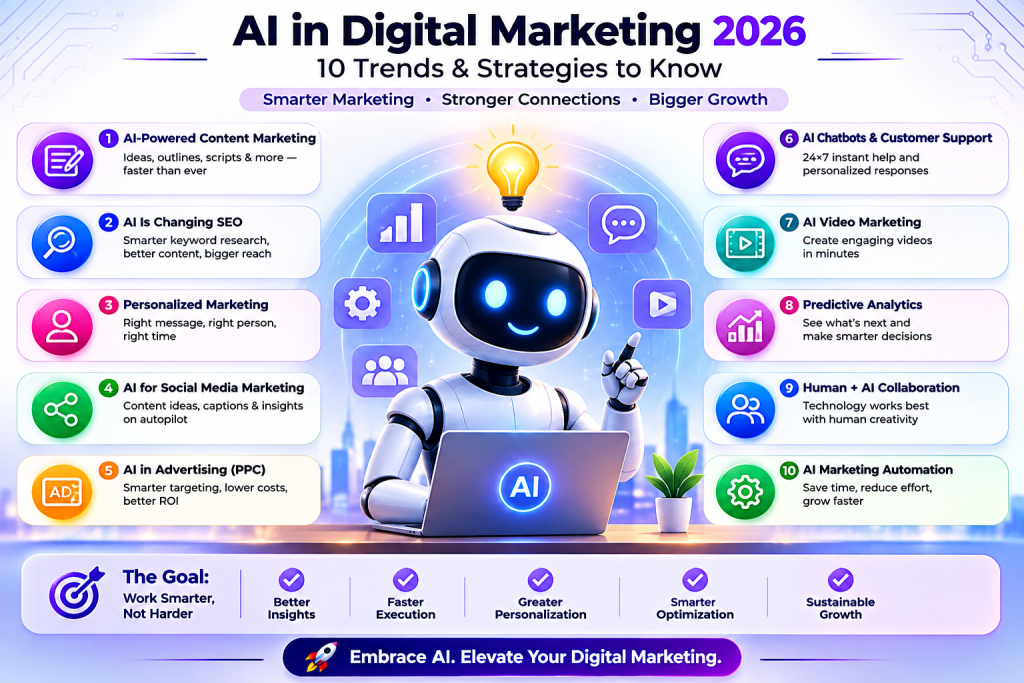
AI in Digital Marketing: 10 Trends and Strategies to Know in 2026
Artificial intelligence is no longer just a futuristic technology discussed by tech companies. In 2026, AI in digital marketing is becoming an important part of how businesses attract customers, create content, understand audiences and improve marketing performance.
From AI-powered SEO and personalized content to predictive analytics and automated customer interactions, businesses can now use AI to make marketing faster and more data-driven.
But there is an important difference between using AI and using AI effectively.
AI can generate content in seconds, analyze huge amounts of data and automate repetitive tasks. However, successful digital marketing still requires strategy, creativity, human understanding and a clear knowledge of the customer.
So, how exactly is AI transforming digital marketing in 2026?
Let’s explore the major trends, practical strategies and ways businesses can use AI without losing the human side of marketing.
What Is AI in Digital Marketing?
AI in digital marketing refers to the use of artificial intelligence technologies to analyze data, understand customer behavior, automate marketing activities and support decision-making.
AI can help marketers with tasks such as:
- Keyword and search intent research
- Content ideation and optimization
- Audience segmentation
- Personalized marketing
- Social media planning
- Advertising optimization
- Customer behavior analysis
- Predictive analytics
- Chatbots and customer support
- Marketing performance analysis
The goal isn’t to replace marketers.
The goal is to help marketers work smarter, make better decisions and spend more time on strategy and creativity.
How Businesses Can Use AI in Digital Marketing
You don’t need to introduce AI into every part of your marketing strategy at once.
Start with repetitive tasks.
Step 1: Identify repetitive marketing tasks
Look at your current workflow.
Which tasks consume the most time?
For example:
- Content research
- Social media planning
- Reporting
- Keyword research
- Data analysis
- Email drafts
Step 2: Choose the right AI tools
Different marketing activities require different tools.
Instead of choosing a tool simply because it is popular, consider:
- What problem does it solve?
- Does it integrate with your workflow?
- Is the output reliable?
- Does it save meaningful time?
- Can your team use it effectively?
Step 3: Keep humans involved
AI-generated output should be reviewed before publication.
Check:
- Accuracy
- Brand voice
- Originality
- Facts
- Relevance
- Customer value
Step 4: Measure the results
Don’t measure AI success only by how much content you produce.
Measure business outcomes such as:
- Website traffic
- Qualified leads
- Conversion rate
- Engagement
- Customer acquisition cost
- Revenue
- Return on investment
AI Marketing Tools Businesses Can Explore
The right tool depends on your marketing goals.
Some commonly used categories include:
| Marketing Need | AI-Assisted Tool Categories |
|---|---|
| Content creation | AI writing assistants |
| SEO | AI SEO and content optimization platforms |
| Design | AI design tools |
| Video | AI video creation and editing platforms |
| Analytics | AI-powered analytics tools |
| Advertising | Automated advertising platforms |
| Customer support | AI chatbot platforms |
| Email marketing | AI-powered email platforms |
Rather than relying on one tool for everything, businesses should build a workflow where different technologies support specific marketing tasks.
What Are the Benefits of AI in Digital Marketing?
When implemented strategically, AI can help businesses achieve several benefits.
Faster Marketing Execution
AI can reduce the time required for research, ideation and repetitive tasks.
Better Data Analysis
AI can process large amounts of information and identify patterns more quickly.
More Personalized Marketing
Businesses can create more relevant experiences for different customer groups.
Improved Productivity
Marketing teams can spend less time on repetitive tasks and more time on strategy.
Better Optimization
AI-assisted insights can help marketers identify opportunities to improve campaigns.
What Are the Challenges of Using AI in Marketing?
AI isn’t perfect.
Businesses should also understand its limitations.
1. Incorrect Information
AI-generated information can sometimes be inaccurate. Important claims should always be verified.
2. Generic Content
If everyone uses AI in the same way, content can become repetitive.
3. Lack of Brand Personality
AI can produce grammatically correct content that doesn’t necessarily sound like your business.
4. Privacy Concerns
Businesses need to handle customer data responsibly and follow applicable privacy requirements.
5. Over-Automation
Automating every customer interaction can make a brand feel impersonal.
The solution isn’t avoiding AI.
It’s using AI responsibly and strategically.
What Are the Challenges of Using AI in Marketing?
AI isn’t perfect.
Businesses should also understand its limitations.
1. Incorrect Information
AI-generated information can sometimes be inaccurate. Important claims should always be verified.
2. Generic Content
If everyone uses AI in the same way, content can become repetitive.
3. Lack of Brand Personality
AI can produce grammatically correct content that doesn’t necessarily sound like your business.
4. Privacy Concerns
Businesses need to handle customer data responsibly and follow applicable privacy requirements.
5. Over-Automation
Automating every customer interaction can make a brand feel impersonal.
The solution isn’t avoiding AI.
It’s using AI responsibly and strategically.
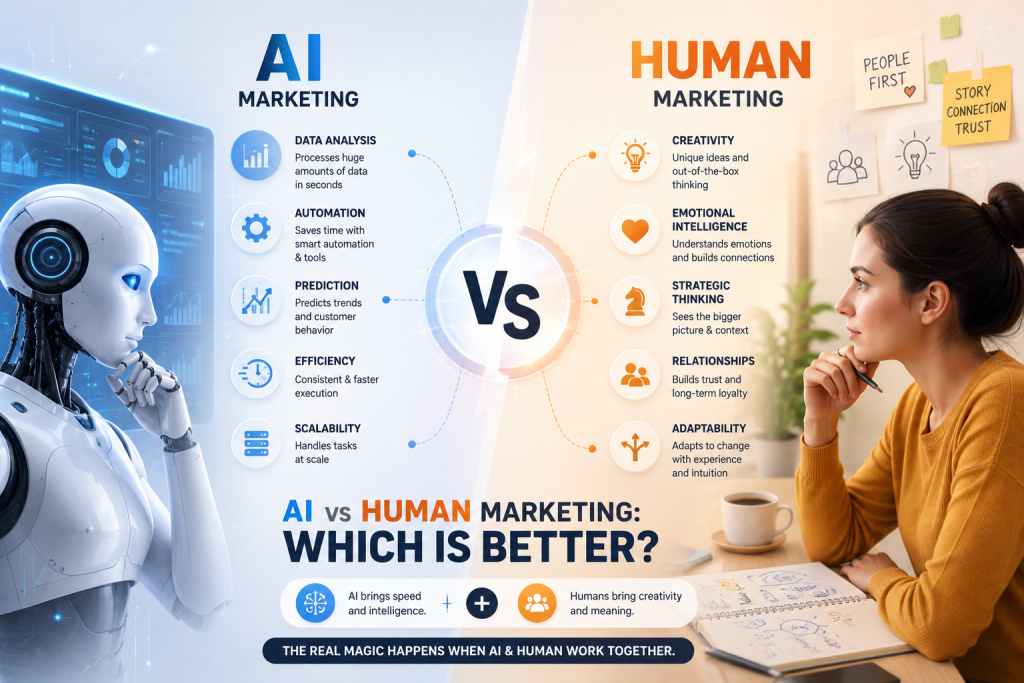
AI vs Human Marketing: Which Is Better?
The question shouldn’t be:
“AI or humans?”
A better question is:
“How can humans and AI work together?”
Imagine a digital marketing team preparing a campaign.
AI can help analyze customer data and generate initial ideas.
The marketing team can then evaluate those ideas, develop the campaign concept, create the brand message and decide which audience to target.
AI accelerates the process.
Humans provide the direction.
The Future of AI in Digital Marketing
AI will continue to influence digital marketing as technologies become more capable.
But one thing is unlikely to change:
Customers still want useful information, trustworthy brands and meaningful experiences.
Businesses that focus only on automation may struggle to build genuine connections.
Businesses that combine technology with strong strategy, creativity and customer understanding will have a stronger foundation for long-term growth.
The future of digital marketing isn’t simply automated.
It’s intelligent, personalized and human-centered.
Final Thoughts
AI is transforming digital marketing in 2026 by changing how businesses research, create, personalize, advertise and measure their marketing efforts.
But AI itself isn’t a marketing strategy.
The real advantage comes from knowing where to use AI, where human expertise is essential and how to connect both with measurable business goals.
Whether you’re a startup, local business or growing company, you can begin with small improvements instead of trying to automate everything at once.
Start with one marketing challenge.
Find the right AI-assisted solution.
Measure the result.
Then scale what works
Frequently Asked Questions (FAQ)
Q1: What are the biggest AI marketing trends in 2026? The biggest trends include Answer Engine Optimization (AEO) replacing parts of traditional SEO, agentic AI managing end-to-end campaigns, hyper-personalization through predictive analytics, AI-powered video production, smarter chatbots, and CRM-native AI tools.
Q2: How is AI changing SEO in digital marketing? AI is shifting SEO from pure keyword ranking toward Answer Engine Optimization, where content also needs to be structured clearly enough for AI systems to summarize and cite it directly in AI-generated answers, alongside traditional search results.
Q3: What is agentic AI in marketing? Agentic AI refers to AI systems that can take direct action within marketing workflows — such as launching campaigns, adjusting ad bids, or reallocating budgets — rather than only generating content for a human to act on.
Q4: Are AI tools replacing marketers in 2026? No. Most marketers still edit and adjust AI-generated content to match brand tone and strategy. AI tools handle repetitive, data-heavy tasks, while human judgment remains essential for creativity, brand voice, and strategic decisions.
Q5: What AI tools should small businesses start with? Small businesses generally benefit most from starting with a few focused tools — an AI-powered SEO/content assistant, a chatbot for customer support, and analytics tools built into their existing CRM — rather than adopting many standalone AI platforms at once.
Q6: How does AI improve personalization in digital marketing? AI combines predictive analytics with real-time behavioral data to tailor messaging, offers, and creative to individual users or small audience segments, rather than relying on broad demographic personas.